
STRAIN GAUGES AND 4-20mA CALIBRATION
Written in conjunction with Henry Wijgerse of Tarka Systems in the Netherlands.
Challenge:
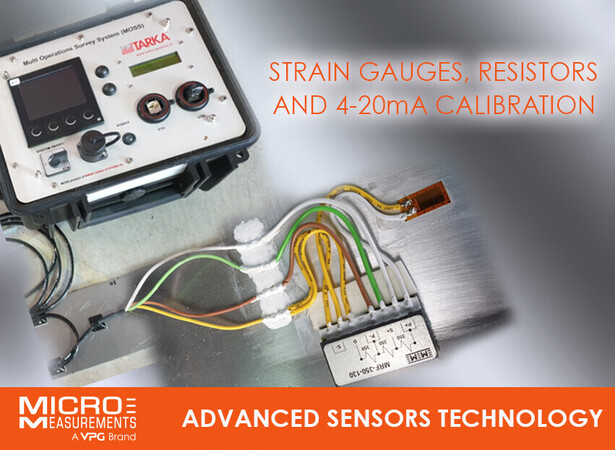
4-20mA data-acquisition devices are designed to accept sensors like accelerometers, load cells and full bridges (with integrated amplifier).
To measure the strain of a quarter-bridge input, the bridge must be completed with resistors to get a full bridge setup.
Additionally it must be set up for zero position and span.
Solution:
Our MRF Bridge Completion Modules (BCMs) contain precision Bulk Metal® Foil resistors to convert a single gauge into a full Wheatstone bridge in a convenient, robust package – all the engineer needs to do is connect four wires from the BCM to the amplifier and three wires to the strain gauge.
To complete the setup to gain a 4-20mA signal, which reflects the strain in the quarter bridge, an additional module (Strain Gauge Amplifier, SGA) was added that can read a bridge signal and converts it into a 4-20mA signal.
For calibration our Model 1550B calibrator can be substituted for the strain gauge to set the zero and span. In this case zero was set to 12mA (to allow plus and minus measurement) with a span of +/-12,000 microstrain. Simple push-button strain values makes this extremely easy.

The customer explains:
A ship monitoring system was built using 4-20mA inputs. This required readings in microstrain so it was essential to use a quarter bridge (one active strain gauge) with the bridge completion module providing the resistors necessary for compatibility with the amplifier.
For the test, this strain gauge and MRF-350-130 bridge completion module are preinstalled on a thin plate to check and verify the readings. Eventually the strain gauges and the BCM are installed directly on the hull (inside) of the ship.
The Model 1550B was used for calibration because it can mimic a quarter bridge and give known specific values of strain at the push of a button. With this setup all SGAs are calibrated and checked in-house. After that all strain gauges, BCM and SGA units are installed on the ship. The monitoring system could then be powered on site with confidence that it can start capturing calibrated data.
Layout of complete system:


TARKA-SYSTEMS
TARKA-SYSTEMS is an innovative company specialized in the development and production of client-specific measurement and monitoring tools and portable data acquisition systems (hardware and software).
The company TARKA-SYSTEMS was founded in 2011 after 15 years world-wide field experience and system development for one of the largest maritime research institute in the world (MARIN, The Netherlands).
Details about TARKA-SYSTEMS and the provided monitoring systems and data-acquisition solutions can be found on the website: www.tarka-systems.nl
Core business of TARKA-SYSTEMS
• To provide client-specific data-acquisition and monitoring solutions.
• To provide complete systems, hardware and software and be a one-stop solution for the client.
• Installation of sensors and monitoring systems on-site
Products used:
Strain Gauges: Advanced Sensors Technology CEA-06-250UWA-350
Bridge Completion Module: MRF-350-130 provides 3 x 350 ohm Bulk Metal® Foil resistors and suitable terminals for connection. Several versions are available for 120, 350, 1000 and 5000 ohm bridge completion ensuring compatibility with common strain gauges and all types of instrumentation.
Model 1550B Strain Indicator Calibrator: capable of simulating quarter, half and true full bridge in 120/350 ohms (or 350/1000 ohms (-S1 version)). Direct microstrain values in 100s, 1000s and 10000s via push buttons, with traceable accuracy of 0.025%.
Advanced Sensors Technology: Cutting-Edge Refinement
Micro-Measurements®, a Vishay Precision Group, Inc. (VPG) brand, has launched a series of products built using its Advanced Sensors strain gage technology.
Addressing the growing demand for force and strain sensors needed to manufacture precision transducers and for stress analysis test and measurements, Micro-Measurements Advanced Sensors strain gages offer a tighter resistance tolerance, improved gage-to-gage repeatability, and better stability than standard strain gages while their advanced fabrication process helps to significantly reduce lead times.



Recent comments