
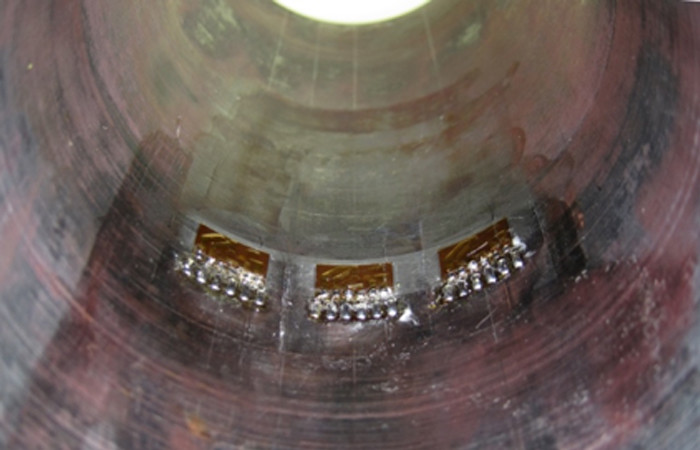
Residual Stress Measurement Inside a Welded Pipe
The inner diameter of pipes is a critical location for design and performance assessment. Corrosion, fatigue, and stress corrosion cracking often attack the pipe’s inner diameter, which can lead to leakage and possible failure of the system. In engineering design, understanding the magnitude and distribution of residual stresses on a pipe’s inner diameter allows accurate structural assessment and planning for inspection. Measuring residual stress on a pipe’s inner diameter is challenging and provides a unique opportunity for innovation.
Hole drilling is a mature technology for the measurement of near-surface residual stress and has been standardized by ASTM in E837. However, while hole drilling is a well-defined method for residual stress measurement, applying it to the inner diameter of pipes comes with additional challenges, including placing a strain gage and drilling a hole with limited access for tooling.
Micro-Measurements CEA-06-062UL-120 strain gages were used in this application due to their small size and high durability. Hill Engineering, LLC designed and manufactured a special guide tool to allow precise and secure mounting of strain gages in pipes of varying diameter and length. In addition, the company developed a miniature precision drilling system that provided measurement access at the pipe’s inner diameter.
During testing, the strain gages placed around the perimeter of the hole were monitored using a Micro-Measurements Model D4 Data Acquisition Conditioner. Following completion of the hole drilling experiment, the strain versus hole depth data were used to compute residual stress. These residual stress measurement data provided engineering a basis for structural integrity assessment and inspection planning.
Click here to read the full Case Study: Residual Stress Measurement Inside a Welded Pipe




Recent comments