
Making Any Measurement Simple
The technical literature on strain measurement can make the subject appear complex and confusing. Indeed, measurements sometimes are complex and confusing. But more often than not they are neither. Regarding of the complexity involved, a successful strain measurement can almost always be achieved when common sense is used to simplify the measurement process by dividing it into logical steps and applying a sound technical understanding to each.
For a metal foil strain gage measurement, the three primary steps are:
-
Strain gage selection and installation
-
Instrumentation selection and data acquisition (DAQ)
-
Data reduction and error analysis.
The stress analyst must pay appropriate attention – not too much and not too little, but just the right amount – to each of these steps every time a measurement is made. What is appropriate for one measurement may not be for the next.
The judgmental skills necessary to decide how much or how little attention is needed in each step can come only from experience and good listening and teaching. Even then, it is all too easy, for example, to become hopelessly entangled in a detailed but meaningless correction of insignificant errors. And no amount of correction – warranted or not- can fully overcome the problem of data that is no darned good in the first place because it was acquired with the wrong gages and instrumentation, or was incorrectly reduced due to a misunderstanding of the technical aspects of the measurement.
Any new stress analysts should be taught to use their common sense and reduce measurement problems to the essentials. Then, by applying experience and knowledge, and carefully considering the relevance of each factor, even the most complex measurement will become simple and straightforward.
What Are My Options to Reduce Measurement Problems?
There are a wide selection of optional features for its general-purpose strain gages and special-purpose sensors. The addition of options to the basic gage construction usually increases the cost, but this is generally offset by the benefits.
Examples are:
-
Significant reduction of installation time and costs.
-
Reduction of the skill level necessary to make dependable installations.
-
Increased reliability of applications.
-
Simplified installation of sensors in difficult locations on components or in the field.
-
Increased protection, both in handling during installation and shielding from the test environment.
-
Achievement of special performance characteristics.
-
Availability of each option varies with gage series and pattern. Standard options are noted for each sensor in the product listing.
Standard Options:
-
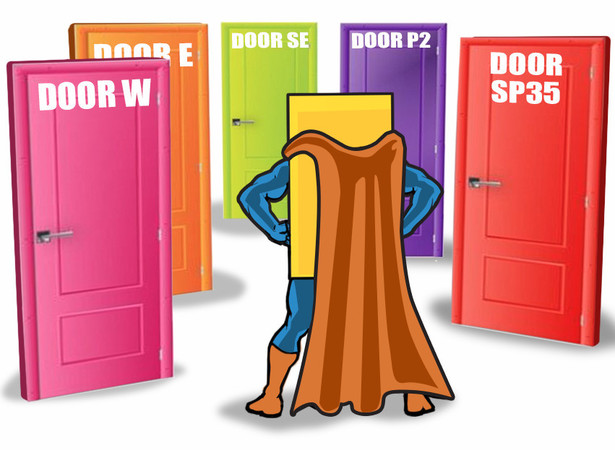
W- Integral Terminals and Encapsulation
-
E- Encapsulation with Exposed Tabs
-
SE- Solder Dots and Encapsulation
-
L- Preattached Leads
-
LE- Preattached Leads and Encapsulation
-
P- Preattached Leadwire Cables and Encapsulation
-
P2- Preattached Leadwire Cables for CEA-Series Gages
-
R- Individually Furnished Resistance Value
-
S- Solder Dots
-
W3 - Special Terminals
-
SP-20: Increases solid-copper jumper wire length to 20 in. Available for C2A
-
SP-35: 10 feet of preattached 30 AWG, twisted, etched Teflon® leadwires. Available for CEA, WK
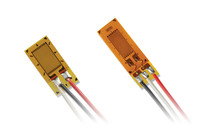
Examples for some special options:
SP-11-14: Single Batch of Foil per Order. Available for all strain gages.
SP21-24: ‘Modulus-Compensating’ Foil. Available for EK, WK, SK, S2K
SP-30: Round Ni-Clad Copper Leads. Available for EA, WA, ED, WD, EK, WK, EP, CEA, WK
SP-60: Special Encapsulation for Manganin strain gages
SP61: Preattached Leads and Encapsulation. Available for N2A, N2P
For More information: http://www.vishaypg.com/docs/11507/OPTFEAT.pdf
Option Selection: https://www.strainblog.com/tips/option-selection
Getting soft around the middle or, what is Modulus compensation?:
https://www.strainblog.com/content/getting-soft-around-middle-or-what-modulus-compensation



Recent comments